
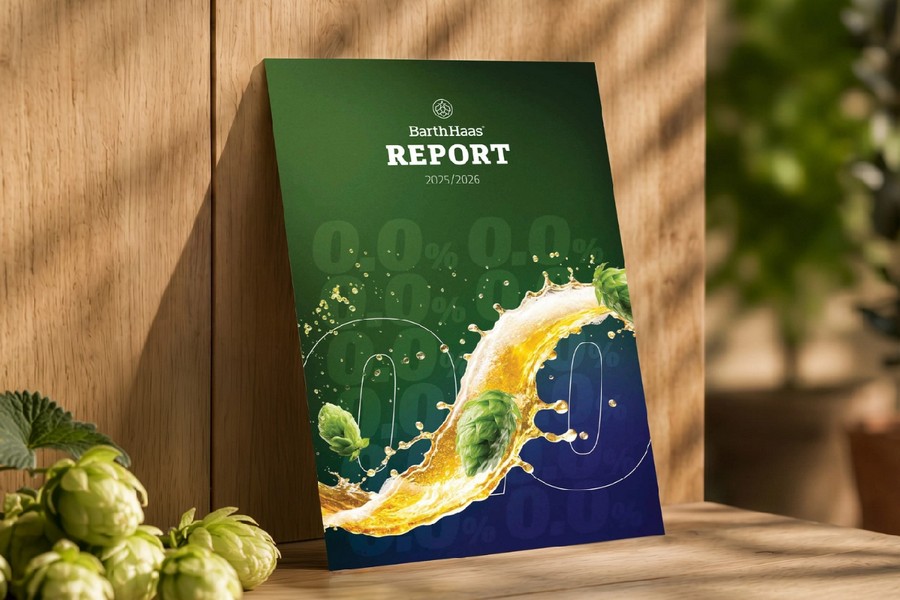
The global hop market remains under significant pressure despite further acreage reductions. That’s the headline from the new BarthHaas Report, which the hop specialist presented yesterday.
Global hop acreage fell by 5.5% to 52,660 hectares in crop year 2025. There was also a decline in crop volume. A total of 109,188 metric tonnes of hops was harvested worldwide, 3.8% less than the year before.
Germany remained the largest hop-growing country, with 18,962 hectares. This represents a year-on-year reduction in acreage of 6.5%. It is followed by the USA in second place, with 17,057 hectares, down from 18,513 hectares the year before.
In crop year 2025, global hop production fell to 109,188 metric tonnes. Average alpha acid content rose slightly from 10.5 to 10.6%. On balance, however, the volume of alpha produced decreased by 3.2% to 11,532 metric tons.
The share of aroma hops in total crop volume and in the volume of alpha acids produced increased, while the share of bitter hops decreased accordingly. In crop year 2025, as in the previous year, Germany accounted for 43% of global alpha volume. The US share fell to 40% (previous year: 41%).
Alpha acid is the most important hop constituent for brewing and is responsible for the bitterness in beer. Hop growers sell their hops partly on the basis of the alpha volume delivered, and alpha acid is also often a price factor in contracts with breweries.
Despite the smaller planted area, hop production still exceeded demand in 2025. Global beer production fell by 0.7% last year to just below 1.9 billion hectolitres. At the same time, hop demand fell by nearly 3% to roughly 10,700 metric tons of alpha acid.
In addition to the lower beer output, the key factors responsible were reduced hop dosage in the brewing process and changes in beer style structure. As a result, there was a surplus of approximately 1,200 metric tonness of alpha acid. This corresponds to a structural overproduction capacity of approximately 5,100 hectares.
“Although acreage has been reduced once again, the market has yet to find equilibrium,” said Heinrich Meier, the author of the BarthHaas report. “Production exceeded demand again in 2025. We expect the current supply balance sheet once more to show a surplus of approximately 1,000 metric tonnes.”
The decline in hop acreage in Germany continues in 2026. According to the Association of German Hop Growers, the planted area currently stands at 17,861 hectares, down 1,101 hectares, or 6%, year on year. Aroma hop acreage has contracted by 715 hectares and that of bitter varieties by 386 hectares. As a result, the balance is shifting slightly in favour of the bitter varieties.
The reduction in planted area worldwide in 2026 amounts to roughly 1,300 hectares. Therefore, according to BarthHaas, the structural surplus persists. At the same time, businesses are coming under further pressure: Production costs in hop growing and processing are rising, while the market continues to be characterised by significant overcapacity, despite the adjustment measures that have been implemented.
“The global hop and beer industry is undergoing a period of far-reaching structural change,” said Thomas Raiser, chief executive of BarthHaas. “A persistent surplus is compounded by changing consumer behavior and mounting economic pressure throughout the entire value chain. What matters now is how adaptable the industry remains, all the way from hop growing to brewing.”
Restoring market equilibrium therefore remains the key challenge. In addition to further structural adjustments, adequate prices and investments in variety development and production efficiency will be crucial to ensuring the long-term competitiveness of the hop industry.